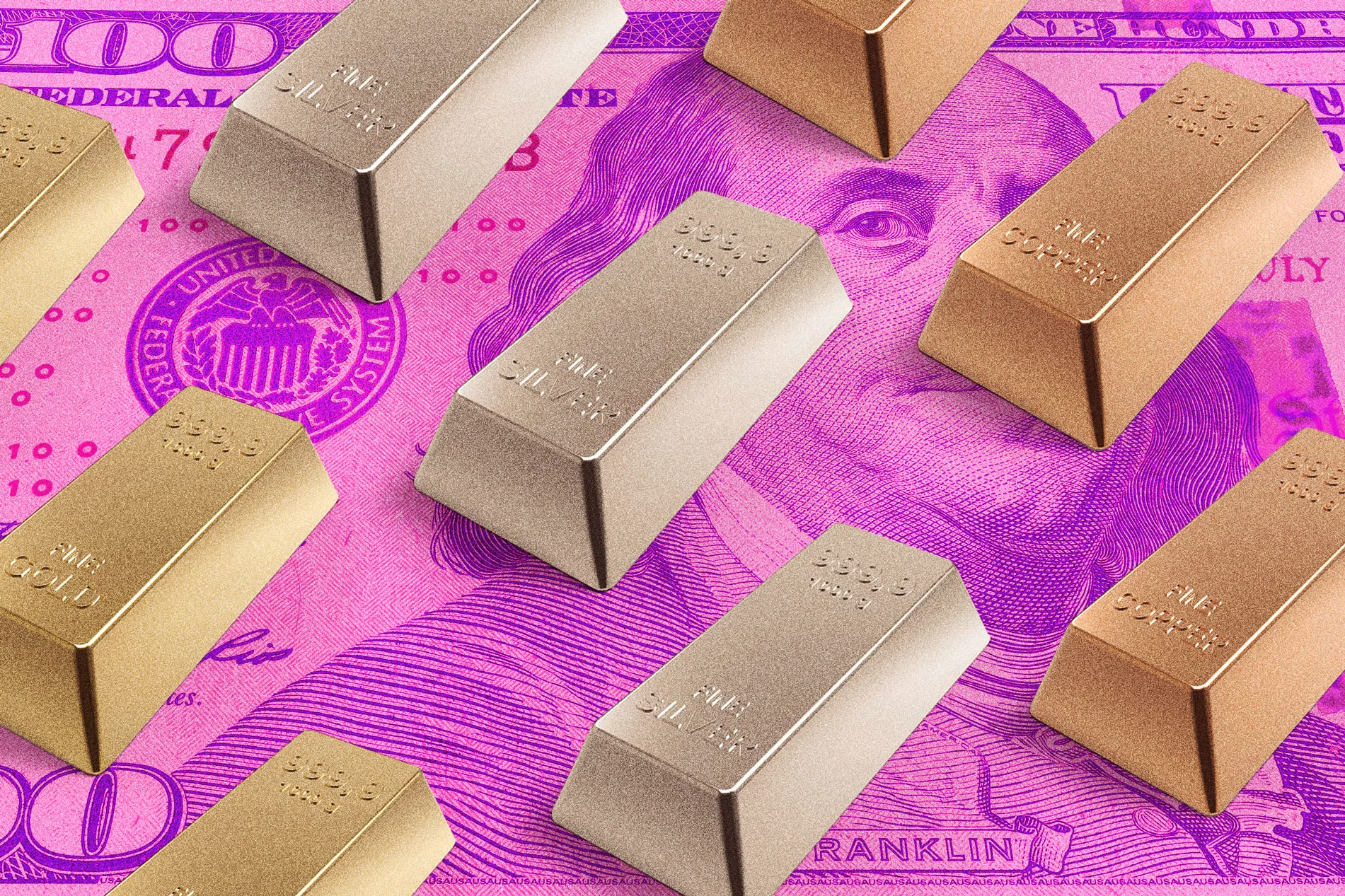

There’s been a lot of focus on gold lately as prices continue to hover near record highs in 2026. As of Feb. 25, 2026, spot gold was trading around $5,150 per troy ounce.
But gold isn’t the only commodity soaring in price. Due to events that have impacted global and domestic supply and demand, a handful of other metals are also increasing in value and challenging all-time highs of their own.
These metals — like silver, copper and aluminum — are flying under the radar while experiencing price surges that might have investors considering opportunities beyond gold.
Why are copper prices rising?
While copper is an industrial metal and not a precious metal, demand for it in China and the U.S. is climbing. Because the principal driver is the green energy transition, this appears to be a sustainable long-term trend. Beyond its manifold industrial applications, copper is a critical component in solar panels, wind turbines, EV charging cables and EV charging stations.
According to Cox Automotive’s Kelley Blue Book, U.S. EV sales hit a record 1.3 million in 2024. And the Energy Information Administration (EIA) notes that annual renewable power generation surpassed nuclear generation in 2021 and coal generation in 2022 — a sign of how quickly electrification and grid buildouts are reshaping U.S. energy demand.
That backdrop has coincided with a sharp run-up in copper prices: The IMF’s global copper benchmark averaged about $12,987 per metric ton in January 2026, up about 10% from December 2025.
As a result, copper-backed equities and funds have drawn attention as well. For investors who want stock-market exposure tied to copper, options include copper-miner exchange-traded funds such as the Global X Copper Miners ETF (COPX).
Silver is surging too
Gold hasn’t been the only precious metal in the spotlight lately. Silver has also seen dramatic swings, with spot silver trading around $88 per ounce as of Feb. 24, 2026.
Demand for the metal continues to outpace supply, as silver and its alloys are integral to the manufacture of batteries, LED chips, medicine, nuclear reactors, solar panels, semiconductors and touchscreens. The Silver Institute expects global silver supply to rise in 2026, but forecasts the market will still face another deficit year — with total supply projected at about 1.05 billion ounces and mine production around 820 million ounces.
Like gold, silver is seen as a safe-haven asset that can perform well during periods of geopolitical unrest — and it can also react sharply to shifts in interest-rate expectations and financial-market volatility.
For investors looking for market-traded exposure to silver, silver-backed ETFs such as the iShares Silver Trust (SLV) remain a popular route.
Tariffs and sanctions are reshaping aluminum prices
Another industrial metal — aluminum — has also pushed higher. The IMF’s global aluminum benchmark averaged about $3,134 per metric ton in January 2026, up about 9% from December 2025.
Trade policy has been a major swing factor. In the U.S., Section 232 aluminum tariffs were doubled to 50% effective June 4, 2025, a move that helped lift U.S. aluminum premiums. At the same time, U.S. and U.K. measures announced in April 2024 restricted the trade of newly produced Russian aluminum (and other metals) on major exchanges, adding another layer of supply-chain friction for global metals markets.
Though it’s difficult to predict short-term swings, aluminum is likely to remain sensitive to supply disruptions and policy shifts — especially as demand continues to rise. According to the World Economic Forum, demand is expected to increase by almost 40% by 2030 as “transportation, construction, packaging and the electrical sectors will drive demand and account for 75% of the total metal required.”
Aluminum-linked equities can also move sharply with the commodity. Century Aluminum (CENX) and Alcoa (AA) are two examples of U.S.-listed producers that investors often watch when aluminum prices surge.
Other metals tagging along — and how to invest safely
Copper, silver and aluminum aren’t the only metals drawing attention in 2026. Tin prices have been especially volatile: the IMF’s global tin benchmark averaged about $49,134 per metric ton in January 2026, up nearly 19% from December 2025. Zinc has also stayed elevated, with the IMF’s global zinc benchmark averaging about $3,207 per metric ton in January 2026.
Platinum and palladium have also posted big moves: spot platinum was around $2,155 per ounce as of Feb. 23, 2026, while palladium was around the mid-$1,700s per ounce in late February.
While base and precious metals are currently surging in price lately, short-term trends shouldn’t dictate your investment strategies. For example, Alcoa’s shares hit an all-time closing high in March 2022 — and later fell by more than 60% from that peak before recovering — illustrating how quickly metal-linked stocks can swing when momentum turns.
A safer approach to diversifying a portfolio with exposure to metals would be choosing an ETF that’s focused on a metal that isn’t being propelled solely by short-term drivers. ETFs provide broad industry exposure by allocating funds across a basket of stocks, and this approach can be undergirded by choosing an ETF focused on a metal with long-term tailwinds.
More from Money:
5 Best Online Gold Dealers of 2024

No responses yet